Monthly Market Commentary – January 2026

The most expensive word in investing: “Later”

Speed read

“Later” can feel cautious in uncertain markets, but it can also create a re-entry challenge. Changing between invested and divested may influence long-term outcomes, depending on timing, market conditions and individual circumstances. One way to reduce the impact is a robust portfolio design process – to help when the world becomes noisy. Diversified portfolios are built to consider different market climates and are aligned to the investor’s objectives, risk tolerance and time horizon.


Key takeaways
  • Waiting until “later” can feel safe, but it can also create a second decision: when (and how) to get back in.
  • With big shifts, like AI, the risk isn’t only drawdowns; it can also be missing compounding and re-entering at less favourable levels.
  • The goal isn’t to predict the next move; it’s to hold a portfolio that can operate across a range of outcomes without relying on a single forecast.
  1. The temptation: “Let’s just wait for clarity” 

Look around and it’s easy to see why investors feel conflicted. Many markets have been strong, yet AI-linked shares draw both excitement and concern, and geopolitics remains noisy. When uncertainty is high and outcomes feel wide, “later” can sound prudent: raising cash, reducing exposure, and waiting for the picture to sharpen.

But investing has an awkward truth: clarity often arrives after prices have already moved. Waiting for certainty is like waiting for the fog to clear before boarding a moving train: by the time you can see clearly, the opportunity may already be gone.

“Later” isn’t a pause button. It’s a decision.

  1. The re-entry problem: the decision you don’t see coming

If you reduce risk because markets feel overheated, you are also making a quiet promise: you’ll increase risk again when things feel better. That sounds sensible, until you run this thought experiment:

  • What if markets rise 50% from here?
  • What if they rise another 50% after that?
  • At what point do you step back in?

That’s the catch. Stepping out is a single decision. Getting back in becomes a series of decisions under pressure, usually when it feels least comfortable to act.  After a strong rise, buying feels reckless (“I’ve missed it”). Staying out starts to feel dangerous (“I can’t afford to miss more”). The longer you wait, the heavier the decision becomes, and the easier it is to make a decision that’s hard to reverse: re-enter too late, too fast, or simply pay too much to get back in.

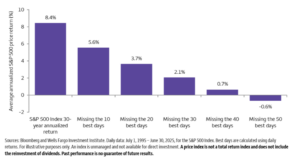
Chart 1: Missing the market’s best days is expensive 

This is one way “later” can become expensive: not because you were wrong once, but because compounding continues while decisions get harder under uncertainty. Missing only a handful of the strongest days can, in some cases, materially change long-term outcomes.

For many investors, the harder part isn’t stepping out; it’s deciding when and how to step back in.

  1. Why prices move without anything “happening” 

This is also why the re-entry decision is so hard. Uncertainty doesn’t only move headlines; it moves prices. Markets reprice while visibility is poor, and by the time confidence returns, valuations and narratives have often shifted.

A simple way to think about valuations is that they rest on two pillars: what we expect the future to look like, and how confident we feel in those expectations. When uncertainty rises, confidence falls. Investors are willing to pay less when the future feels less certain. You can see this in everyday terms: a company can deliver similar results, but if investors feel less certain about next year, the price they’re willing to pay can still fall.

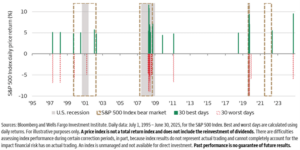
Chart 2: The best days and worst days often occur close together.

Periods of sharp declines and sharp recoveries can occur close together, so stepping aside may increase the risk of missing strong rebound days.

Uncertainty doesn’t just change feelings. It changes prices.

  1. AI as the live example: where “later” thinking shows up most clearly

AI is a live example of how “later” thinking forms. We fixate on what looks expensive today and underestimate what could change across the economy tomorrow. AI may not simply boost the current system; it may reshape where growth shows up over time.

The usual framing is: “These shares are expensive. What do the winners need to earn to justify today’s prices?” It’s a fair question, but it’s incomplete. Some technologies don’t just create new products; they can change the cost and speed of doing business across many industries. The Industrial Revolution didn’t only reward machine builders; it reshaped production and commerce more broadly.

AI may have similar second-order effects. Think of it as lowering the cost of routine cognitive work — drafting and summarising, coding assistance, customer support, fraud detection, scheduling appointments and compliance checks. These are economy-wide activities, which means the effects may reach beyond the handful of tech companies most associated with the theme.

We don’t know exactly how the benefits of AI will manifest. Its potential appears significant, though outcomes remain uncertain. Investors concerned about concentration sometimes manage this by avoiding heavy single-theme exposure while maintaining broad diversification that may still participate if benefits spread more widely.

Structural shifts can create opportunities, but they can also increase volatility and dispersion of returns. Broad, diversified exposure is one way investors sometimes seek to participate without relying on a single forecast.

  1. A more durable stance: don’t bet the plan on one story

None of this is a call to go all-in on AI. That’s simply another form of overreacting. A more measured approach, for many investors, is to acknowledge uncertainty without assuming it can be neatly timed: keep exposure broad rather than highly concentrated, and aim for a risk level aligned to objectives so decisions are less likely to be made under pressure.

There’s a deeper reason diversification matters. Research on long-term equity wealth creation suggests a surprisingly small subset of companies accounts for a large share of lifetime market gains. You don’t need to pick every winner, but broad exposure can reduce the risk of systematically missing them. Uncertainty may justify different actions for different investors. A disciplined approach-involving diversification, a suitable risk level and periodic review – may help manage behavioural risks, but it does not prevent losses or guarantee outcomes.

Different investors choose different routes. The key is selecting one that fits the destination and the bumps you can tolerate.

  1. How PortfolioMetrix responds when uncertainty is high

PortfolioMetrix applies a robust investment process intended to support long-term discipline through different market conditions. This typically includes calibrating risk, diversification, periodic rebalancing and ongoing review. These measures aim to manage portfolio risk and support decision-making, but they cannot prevent losses or guarantee outcomes. Frequent changes to investment positioning may increase uncertainty around outcomes and may not align with long-term objectives for some investors, particularly when decisions are made in periods of stress.

In practice, that means:

  • Aligning risk to the client journey – aiming to reduce the chance and impact of clients abandoning the plan when markets feel uncomfortable.
  • Diversifying deliberately – so no single theme or narrative dominates outcomes.
  • Rebalancing with discipline – helping to avoid buying and selling becoming emotion-driven.
  • Building behavioural guardrails – so “later” doesn’t become a cycle of stepping off and scrambling back on.

These practices are intended to reduce emotion-driven decisions. They may help some investors stay aligned to their plan, but results will vary and costs and risks remain.

Markets will always offer reasons to say “later”; a robust, structured process is one way some investors try to stay aligned to their objectives, even when headlines are noisy.

  1. What to do with this, this month

The world can get noisier from here, and markets can fall, sometimes quickly. But “later” is not a free option: it creates a second decision later, often under different conditions.

A useful question is: “If I’m wrong, what does that do to my plan, and how hard will it be to fix?” In uncertain markets, the edge is rarely a bold prediction. For many investors, it’s composure, diversification and process — while recognising the trade-offs, costs and risks that come with changing course.

If you’re considering changes, it can help to test them against objectives, time horizon and risk tolerance. Some investors use scheduled reviews and rebalancing policies as part of a long-term approach, while keeping in mind the risks and potential costs.

LOCAL DRIVERS

Emerging Market Rally and Rand Strength

South Africa benefitted from a broader emerging-market rally, supported by a weaker US dollar, firmer commodity prices and renewed global risk appetite. The rand strengthened in to R17.20/$, aided by continued foreign demand for high real-yield local bonds and money-market assets. While the move was largely driven by global capital flows rather than domestic growth fundamentals, a firmer currency helped contain imported inflation pressures and supported confidence in South African assets. The rand’s performance remains highly sensitive to shifts in global sentiment, highlighting the external nature of this suppor

SA Macro Stability: Low Infaltion

December headline CPI was 3.6% y/y, placing it comfortably within the SARB’s newly emphasised 2–4% inflation range. Easing food and fuel price pressures, alongside disciplined monetary policy, have helped pull inflation expectations steadily lower toward 3%, reinforcing the credibility of the revised inflation regime. Against this backdrop, the SARB maintained a cautious but increasingly supportive stance, signalling that real interest rates are sufficiently restrictive and that policy flexibility could increase if conditions allow. This environment has been constructive for bond markets, household purchasing power and interest-rate-sensitive sectors of the economy

Structural Reforms and Investment Climate Improvements

Incremental progress on structural reforms continued to shape South Africa’s medium-term outlook, particularly in electricity and logistics under Operation Vulindlela. Ongoing steps to expand private power generation capacity and advance port and rail concessions aim to ease long-standing constraints that have capped growth. Government has reiterated infrastructure commitments exceeding R1 trillion over the medium term, while multilateral funding support has helped de-risk priority projects. Although implementation remains uneven, steady reform momentum has improved investor sentiment and strengthened expectations that South Africa’s growth ceiling can gradually lift if execution continues.

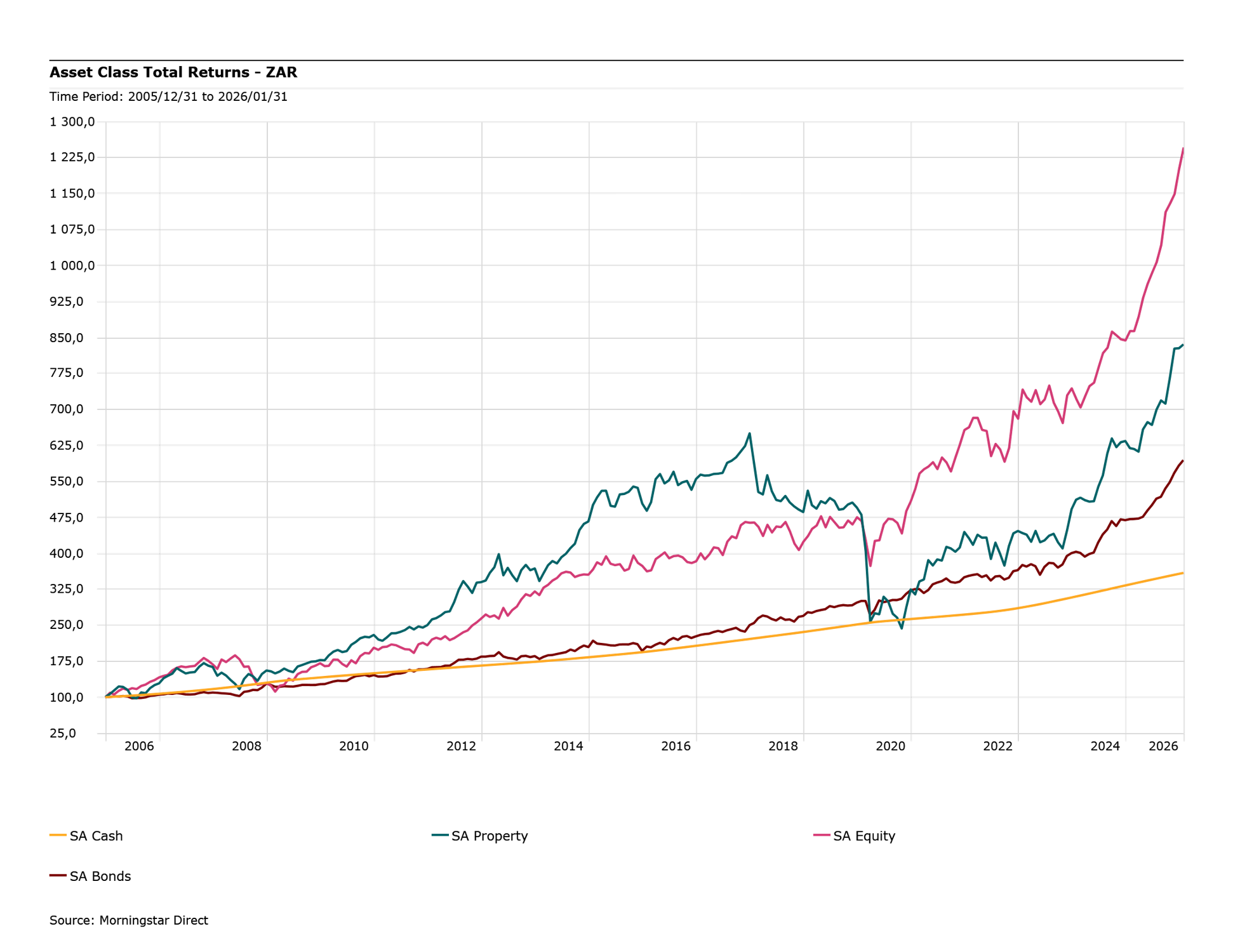
ASSET CLASS TOTAL RETURNS – ZAR
GLOBAL DRIVERS

Global Monetary Policy Divergence

January reinforced monetary policy divergence across major economies as inflation and growth dynamics evolved unevenly. The US Fed kept policy rates at 3.5-3.75%, signalling patience amid resilient labour markets and sticky services inflation. Parts of Europe remained cautious as weak growth offset easing price pressures, while several emerging-market central banks leaned toward earlier easing as inflation moderated faster. This divergence widened interest-rate differentials, driving FX volatility, capital flows and relative bond and equity performance. As a result, policy expectations remained the most powerful macro force affecting global asset pricing during the month.

Emerging Markets Lead Global Growth Projections

Global growth expectations pointed to continued rebalancing toward emerging markets, with Asia projected to deliver over half of incremental global GDP growth. Advanced Economies (Europe, UK, USA) are expected to grow slower, around 1.8%, constrained by tighter financial conditions and fiscal consolidation. In contrast, Emerging Economies (Asia, Lat. America, Africa) are expected to grow faster at 4.2%, supported by domestic demand and structural investment. China’s outlook remained stable but modest, reflecting targeted rather than aggressive policy support. This uneven growth backdrop encouraged capital rotation toward emerging markets and commodities, driving relative performance across regions and sectors.

Geopolitical Risk, Trade Policy and Market Volatility

Geopolitical risk remained a source of volatility, periodically disrupting otherwise supportive macro trends. Uncertainty around trade policy, supply chains and regional conflicts contributed to episodic risk-off moves, spikes in volatility and renewed demand for safe-haven assets such as gold and government bonds. Commodity markets were particularly sensitive, with oil and precious metals reacting sharply to geopolitical headlines despite broadly balanced fundamentals. While these developments did not materially alter the global growth outlook, they increased risk premia and short-term market instability, acting primarily as a volatility amplifier rather than a sustained directional driver.

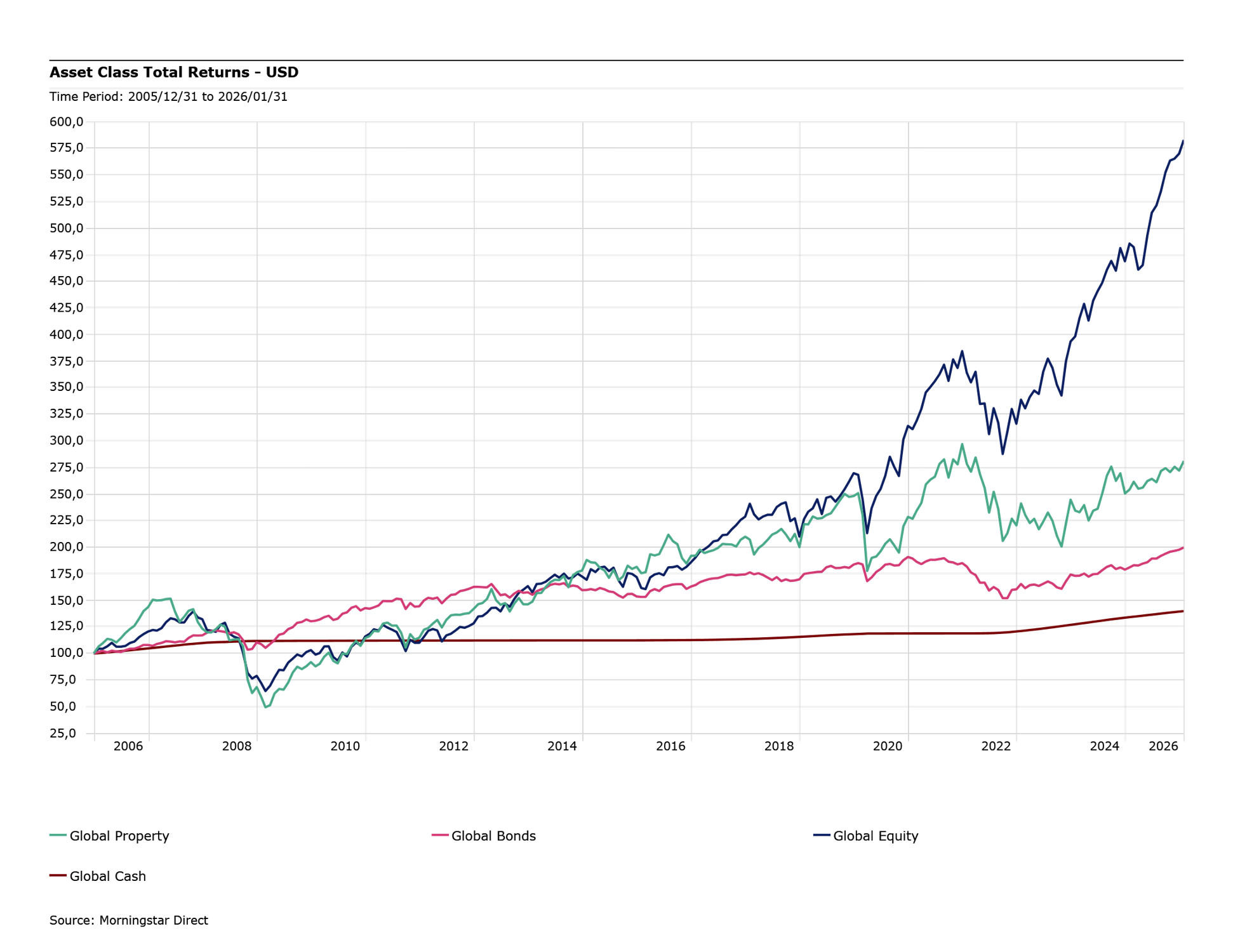
ASSET CLASS TOTAL RETURNS – USD
Global Review, Investment Advisory, Investments, Market Commentary, Markets, Wealth Management

SHARE THIS ARTICLE